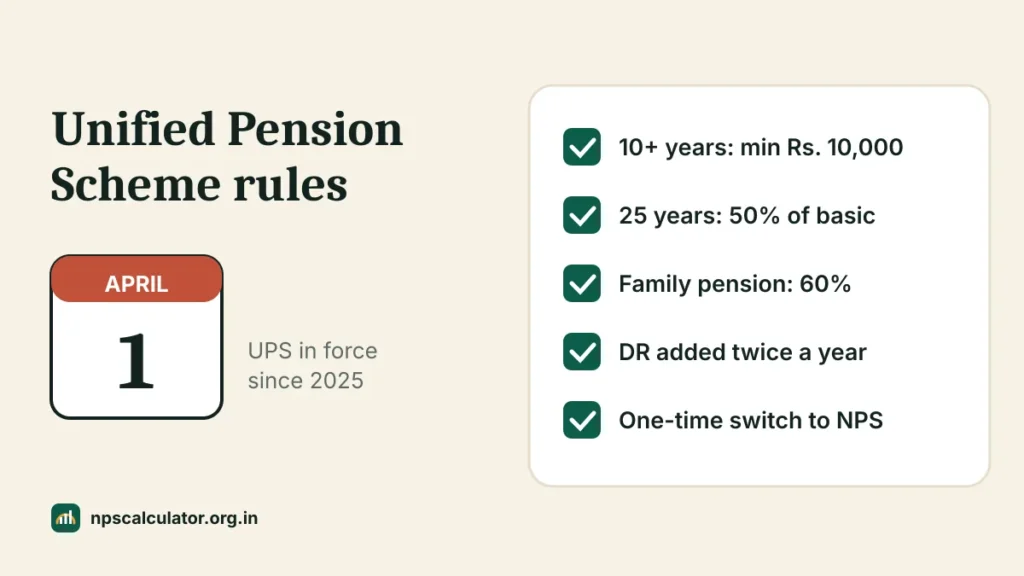
The Unified Pension Scheme (UPS) is an option within NPS for Central Government employees, in force from 1 April 2025. It promises an assured monthly payout of 50% of average basic pay for 25 years of service, a minimum of Rs. 10,000, family pension of 60%, Dearness Relief, and a lumpsum at superannuation. This guide covers every rule, the latest circulars, and how to decide.
UPS key features
Who is eligible
- Central Government employees covered by NPS in service on 1 April 2025 who opted for UPS.
- New Central Government recruits joining on or after 1 April 2025, who choose UPS at joining.
- Employees who retired under NPS before 1 April 2025 (and spouses of deceased retirees) could opt in and receive arrears, adjusted for amounts already received.
- The opting window for existing employees and past retirees was extended to 30 November 2025.
How the UPS payout is worked out
Full payout = 50% of the average basic pay drawn in the 12 months before superannuation, for qualifying service of 25 years or more. For 10 to 25 years it is proportionate. For example, 20 years of service gives 20/25 x 50% = 40% of average basic. The floor is Rs. 10,000 a month for 10+ years. Dearness Relief is added and revised twice a year. Calculate yours in the UPS calculator.
If your individual corpus at retirement is below the benchmark corpus (what it would be with all contributions invested in the default scheme), the payout is reduced proportionately. If you withdraw part of your individual corpus (up to 60%), the payout is reduced in the same proportion.
Lumpsum and gratuity
At superannuation you get a lumpsum of one-tenth of monthly emoluments (basic + DA) for every completed six months of qualifying service. This is in addition to gratuity under the CCS rules (up to Rs. 25 lakh). The lumpsum does not reduce the assured payout.
Situations and what happens
| Situation | Outcome under UPS |
|---|---|
| Superannuation with 25+ years | Full 50% payout + DR, lumpsum |
| Superannuation with 10 to 25 years | Proportionate payout (minimum Rs. 10,000) + DR, lumpsum |
| Less than 10 years | No assured payout; corpus rules of NPS apply |
| Voluntary retirement after 25 years | Payout from the date you would have superannuated |
| Death after retirement | Family pension at 60% to legally wedded spouse |
| Resignation, removal or dismissal | No assured payout |
Switching from UPS to NPS
A UPS subscriber can switch back to NPS once: at the latest one year before superannuation, or three months before voluntary retirement (and not in cases of removal, dismissal or disciplinary proceedings). After switching, you cannot return to UPS, and the assured payout no longer applies; your corpus then follows NPS exit rules.
Latest UPS circulars (2026)
- 30 October 2026, PFRDA: UPS Jeewan Setu, an Aadhaar-based digital life certificate through the NPS by Protean app; UPS pensioners must submit their life certificate by 30 November each year. Read.
- 27 October 2026, DoPPW: contributions during suspension are optional, during probation mandatory; adjustments after the final order. Read.
- States including Maharashtra and Manipur have approved UPS-style schemes for their own employees.
UPS or NPS?
UPS trades a large lumpsum and inheritable corpus for a guaranteed, inflation-indexed income. Employees with long service and a strong preference for certainty usually find UPS attractive; young recruits who expect high equity returns and want a big lumpsum may prefer NPS. Run both with your numbers in the UPS vs NPS calculator.
Frequently asked questions
When did UPS start?
UPS was notified on 24 January 2025 and came into force on 1 April 2025.
Is UPS the same as the Old Pension Scheme?
No. UPS is contributory (employees pay 10%), the payout depends on the last 12 months’ average basic and on service length, and you do not get GPF or commutation. OPS was non-contributory.
Is DR given on UPS family pension?
Yes, Dearness Relief applies to both the assured payout and family pension.
Do UPS pensioners need a life certificate?
Yes, every year by 30 November. It can be submitted digitally through UPS Jeewan Setu.
Sources
- Ministry of Finance notification on UPS, 24 January 2025
- PFRDA (Operationalisation of UPS under NPS) Regulations, 2025; PFRDA circular PFRDA/2026/54/SUP-CG-SG/02 (30 Oct 2026)
- CCS (Implementation of UPS under NPS) Rules, 2025; DoPPW OM dated 27 Oct 2026